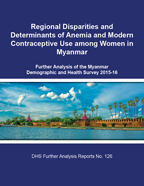
There is no printed copy available to order.
Abstract:
Geographic disparities are an important
consideration in the health equity of a
country. Understanding regional disparities,
the determinants of anemia, and the use of
modern contraception by women of reproductive
age would help to reduce the anemic burden,
unwanted pregnancy, and related deaths. The
aim of this study is to determine regional
disparities and determinants of anemic health
outcomes and use of modern contraception
methods by women of reproductive age in
Myanmar. The study is a secondary analysis
that used cross-sectional data from the 2015-
16 Myanmar Demographic and Health Survey. The
unit of analysis for the anemic outcome is
based on weighted samples of 12,489 eligible
women of reproductive age (age 15-49).
Analysis of modern contraception use was
restricted to a weighted sample of 12,419
women age 15-49 who were not currently
pregnant.
The findings show that there are regional
disparities in anemia and use of modern
contraception within geographical zones, and
that the disparities across States and
Regions in Myanmar were especially large.
Rakhine State in the Coastal zone was the
most vulnerable region for anemic disparities
(55.4%), while women of Chin State (17.5%) in
the Hilly zone and Rakhine State (23%) in the
Coastal zone were the least likely to use
modern contraception. The determinants for
anemia were biological and factors related to
pregnancy, and not socioeconomic factors.
Determinants of the use of modern
contraception methods were region, age,
education, marital status, wealth, and number
of children. Regional disparities in anemia
health outcomes and the low use of modern
contraception methods remain major public
health problems in Myanmar.
The study recommends qualitative research
that would explore food patterns and nutrient
contents of households in the assessment of
anemia status and cultural perspectives on
family planning methods among communities in
the different geographic areas. Providing
iron tablets for women of reproductive age
and all pregnant women would be the easiest,
most effective way to prevent anemia in
women. Investments in family planning and
maternal and child health care services that
focus on vulnerable areas in Myanmar would be
a better solution for narrowing the
geographic disparities in Myanmar.